Wechsler Preschool & Primary Scale of Intelligence - Fourth Edition Australian and New Zealand Standardised Edition
WPPSI-IV A&NZ
Measures cognitive development for preschoolers and young children- Publication date:
- 2014
- Completion time:
- Core Subtests: Ages 2:6 to 3:11: 30-45 Minutes, Ages 4:0 to 7:7: 45-60 Minutes
- Administration:
- Individual; Q-global® scoring, and/or reporting, or manual scoring
- Age range:
- 2 years and 6 months to 7 years and 7 months
- Qualification level:
- C

"This report didn’t just explain my child, it explained our whole life.’ That’s the power of assessment."
Renee Testa, Psychologist
Listen to Renee's story
The WPPSI–IV A&NZ is an innovative measure of cognitive development for preschoolers and young children that’s rooted in contemporary theory and research. This edition also places a strong emphasis on child-friendly, developmentally appropriate features, and includes new processing speed tasks, the addition of working memory subtests and an expanded factor structure. These extensive enhancements are targeted to benefit both children and examiners.
The WPPSI–IV A&NZ is an innovative measure of cognitive development for preschoolers and young children that’s rooted in contemporary theory and research. This edition also places a strong emphasis on child-friendly, developmentally appropriate features, and includes new processing speed tasks, the addition of working memory subtests and an expanded factor structure. These extensive enhancements are targeted to benefit both children and examiners.
New Australian & New Zealand Norms
The WPPSI–IV A&NZ has been standardised on Australian and New Zealand children aged 2:6–7:7. The normative sample is representative of the Australian and NZ census for age, gender, parental education, geographic location, and indigenous status.
New Working Memory subtests
Picture Memory and Zoo Locations, the two new working memory subtests provide age appropriate, engaging tasks for children as young as 2 ½. These reliable and child-friendly measures were specifically designed to help detect emerging working memory difficulties for early intervention.
Expanded and Updated Factor Structure
| Full Scale | |
| Verbal Comprehension Receptive Vocabulary Information Picture Naming | Visual Spatial Block Design Object Assembly Working Memory Picture Memory Zoo Locations |
| Primary Index Scales | |
| Verbal Comprehension Receptive Vocabulary Information | Visual Spatial Block Design Object Assembly Working Memory Picture Memory Zoo Locations |
| Ancillary Index Scales | |
| Vocabulary Acquisition Receptive Vocabulary Picture Naming | Nonverbal Block Design Object Assembly Picture Memory Zoo Locations General Ability Receptive Vocabulary Information Picture Naming Block Design Object Assembly |
| Full Scale | ||
| Verbal Comprehension Information Similarities Vocabulary Comprehension | Visual Spatial Block Design Object Assembly Fluid Reasoning Matrix Reasoning Picture Concepts | Working Memory Picture Memory Zoo Locations Processing Speed Bug Search Cancellation Animal Coding |
| Primary Index Scales | ||
| Verbal Comprehension Information Similarities | Visual Spatial Block Design Object Assembly Fluid Reasoning Matrix Reasoning Picture Concepts | Working Memory Picture Memory Zoo Locations Processing Speed Bug Search Cancellation |
| Ancillary Index Scales | ||
| Vocabulary Acquisition Receptive Vocabulary Picture Naming | Nonverbal Block Design Object Assembly Matrix Reasoning Picture Concepts Picture Memory Zoo Locations Bug Search Cancellation Animal Coding | General Ability Information Similarities Vocabulary Comprehension Block Design Object Assembly Matrix Reasoning Picture Concepts Cognitive Proficiency Picture Memory Zoo Locations Bug Search Cancellation Animal Coding |
For both age bands the test structure includes three levels of interpretation: Full scale, Primary Index scale and Ancillary Index scale levels.
Improved Developmental Appropriateness
With consideration of the unique challenges of assessing young children, the WPPSI–IV was redesigned to strengthen the emphasis on ensuring all aspects of the WPPSI–IV are developmentally appropriate.
New Processing Speed Subtests
The three new game-like subtests offer engaging art and use an ink dauber to indicate responses, which minimises fine motor demands. Each subtest is built with careful consideration to the cognitive, motor, and language development of young children.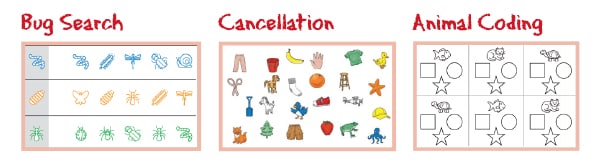
Simplified Instructions
- Simplified and shortened directions for children
- Demonstration, sample and teaching items used whenever possible to ensure clarity of task demands
More Efficient Test Administration
Numerous updates make administration as efficient and user-friendly as possible.
- Testing time is maintained or reduced while construct coverage is increased.
- Clear and concise examiner instructions, including shortened discontinue criteria and simplified substitution, invalidation, and proration rules.
- Stimulus book contents distributed to maximise portability
- New and durable storage solutions for manipulatives, including puzzles.
Improved Clinical Utility
Updates increase the practical usefulness of the WPPSI–IV.
- Age range extended upward to 7 years 7 months
- Scoring approach expanded to include strengths and weaknesses analysis at the index level
- Reduced expressive language requirements
- Updated and new special group studies
Q-global®
In addition to hand scoring, WPPSI-IV A&NZ is available on Q-global, Pearson’s web-based scoring and reporting platform.
Q-global offers:
- 24/7 secure, web-based access
- Portability: Q-global can be used on mobile devices such as a laptop or tablet
- On-demand, reliable scoring and comprehensive reporting solutions
- Pricing available as per-report or subscription. Subscriptions are annual for one (1) per instrument, per user

In each episode, you’ll meet someone who makes a profound difference in other people’s wellbeing every single day.
The following resources are available for WPPSI–IV A&NZ.
Training
Introductory online training series
This pre-recorded 20–30 minute session allows you to learn at your leisure. All you need is internet access and sound enabled on your computer. Please note the session may take a few minutes to load.
- Overview of WPPSI–IV revision goals
- Developmentally appropriate features
- Working memory
- Core factor structure
WPPSI–IV Manual Supplement
Results of the WPPSI–IV special group validity studies (USA): WPPSI–IV Technical and Interpretive Manual Supplement
Getting started with Q-global: training series
View these brief training modules about Q-global:
- Module 1: Gaining access to Q-global
- Module 2: Signing in and setting up your account
- Module 3: Managing sub-accounts
- Module 4: How to generate reports
- Module 5: WPPSI–IV Score Reports using Q-global
Content modification (Australia & New Zealand)
We wish to advise a content modification to pages 364–365 of the Administration and Scoring Manual, Table D.5 “Base Rates of Normative Sample Obtaining Various Differences Between the GAI and Selected WPPSI–IV Composite Scores, by Overall Sample.” Following review, all table data are correct. This modification does not affect norms, reliability, or validity. To improve clarity, column headings are being updated and will appear in the next printing.
Please choose one of the following options:
- Download replacement pages to print and glue over pages 364–365.
- Manually modify pages by switching the “–” and “+” labels on pages 364–365. Manual edits >
- Request a sticker to place over the existing labels. Please call or email Client Services for replacement stickers: info@pearsonclinical.com.au
If you have any questions, please contact our Client Services team on 1800 882 385 (AUS, toll-free) or 0800 942 722 (NZ, toll-free), or email us at info@pearsonclinical.com.au.
WPPSI–IV A&NZ reports on Q-global
Score Reports
- Automatically converts total raw scores to subtest scaled scores
- Automatically converts sums of scaled scores to composite scores (FSIQ and index scores)
- Provides strengths-and-weaknesses analysis at index and subtest levels
- Performs score comparisons at index and subtest levels
- Generates score reports with tables and graphs
Interpretive Report
In addition to full scoring information, this report includes narrative interpretation of scores, including:
- Narrative summary of the child’s background, history, and test behaviours
- Interpretation of the Full Scale IQ and all primary and ancillary index scores
- Integration of the reason for referral in test-score interpretation
- Recommendations based on WPPSI–IV A&NZ performance
- Optional Parent Summary Report
Here are some frequently asked questions about WPPSI-IV A&NZ:
Test Framework, Revision Goals, and General Practice Issues
The changes in the test structure were influenced by contemporary structural models of intelligence, neurodevelopmental theory and neurocognitive research, clinical utility and factor-analytic studies. Changes include new and separate Visual Spatial and Fluid Reasoning index scores for ages 4:0–7:7, new measures of working memory, and a new working memory composite. The separation of Visual Spatial and Fluid Reasoning composites results in greater interpretive clarity, and the addition of working memory enhances the scale's clinical utility due to its sensitivity to a wide variety of clinical conditions and important outcomes (e.g., achievement).
Yes. New picture items were added to Similarities and Comprehension to ensure that children aged 4:0–7:7 with expressive language issues can indicate responses to some items even if they cannot or do not speak at all. These items provide children with expressive language issues an opportunity to demonstrate verbal concept formation and comprehension without a verbal response. Only Vocabulary and Picture Naming require expressive responses on the floor items, and neither of these subtests are core to the primary index scores or FSIQ for either age band. Also, two ancillary index scores, the Verbal Acquisition Index (VAI) and the Nonverbal Index (NVI), provide additional information about the performance of children with expressive language issues.
Working memory is a key aspect of intellectual functioning, with strong ties to fluid reasoning. It is also implicated in a wide variety of academic problems and clinical conditions that affect young children. Accordingly, the incorporation of working memory measures was a revision goal from the beginning of WPPSI-IV development.
The instructions for the Working Memory subtests are succinct, supported by active demonstration and practice to supplement verbal instruction. These were tested with very young children and those with intellectual disabilities to ensure accessibility. Studies showed no significant differences between English Language Learners and control groups.
Traditional verbal working memory tasks are often developmentally inappropriate for children in this age range. Visual working memory is more suitable and linked to processing efficiency. Auditory working memory remains relevant for older age groups but was limited here to reduce verbal demand variability.
The new subtests are more play-like and developmentally appropriate. They use familiar stimuli, an ink dauber instead of a pencil, and simplified instructions to suit young children’s cognitive and motor development.
The WPPSI-IV reflects CHC theory and other structural models but was not based solely on any one theory. It integrates neurodevelopmental research and clinical utility, aligning with CHC domains such as Gc, Gv, Gf, Gsm, and Gs.
Testing time is comparable to the WPPSI-III and varies depending on which composite scores are selected. Some administrations may be shorter or slightly longer depending on practitioner choices.
Yes. Representative proportions of children with clinical conditions and giftedness were included to reflect the population accurately. Their inclusion is minimal and does not distort the normative data.
Use the WPPSI-IV for children with below-average ability, limited language skills, or expressive difficulties. Use the WISC-IV for high-ability children. For average-ability children, professional judgment based on test familiarity and referral reasons should guide selection.
Most practitioners transition within 8–12 months of a new edition’s release. Ethical guidelines recommend using the most current version for valid and defensible results.
The FSIQ is preferred for general ability–achievement comparisons, but other composites (VCI, VSI, FRI, GAI, or NVI) may be more appropriate depending on the child’s profile.
Yes. The Q-global WPPSI-IV/WIAT-III combination reports support PSW analyses through automated discrepancy evaluations unavailable in paper form.
Subtests
Decisions on core versus supplemental subtests considered psychometric properties, construct coverage, reliability, validity, and feedback from practitioners. Vocabulary and Comprehension still provide valuable qualitative insights into expressive and receptive language.
Information was chosen due to strong reliability, efficiency, and minimal expressive demand. Both Vocabulary and Information are valid measures of crystallised knowledge (g), but Information offers faster administration and equivalent reliability.
It overlapped with Vocabulary and lacked strong validity as a fluid reasoning measure. With improved floors on Similarities and Comprehension, its inclusion was unnecessary.
To reduce emphasis on processing speed and accommodate new subtests, such as those measuring working memory.
Depending on severity, the task may still be appropriate. The grids are large, but if not feasible, Zoo Locations can be omitted without affecting FSIQ (though WMI or ancillary scores may be unavailable).
Composite Scores and Indexes
The WPPSI-IV includes working memory and more developmentally appropriate measures of processing speed, offering a more balanced and comprehensive FSIQ.
The FSIQ reflects overall ability (g), while the indexes represent specific cognitive domains (e.g., verbal, visual-spatial, reasoning, working memory, processing speed).
The GAI provides an estimate of general ability with reduced influence from working memory and processing speed, useful for children with attention or processing difficulties.
Visual working memory, attention, concentration, and the ability to hold and manipulate information.
Primary indexes are factor-based measures (VCI, VSI, FRI, WMI, PSI). Ancillary indexes (VAI, NVI, GAI, CPI) provide additional clinical insight, such as verbal acquisition or nonverbal reasoning.
One substitution is permitted for multi-subtest composites (e.g., FSIQ, NVI, GAI, CPI). Proration is available for FSIQ only under defined conditions. Substitutions must stay within the same cognitive domain.
- Composite scores are often described in qualitative terms according to the examinee’s level of performance relative to same-age peers. The descriptors are useful for clear communication of results to individuals who are unfamiliar with quantitative test results. Qualitative descriptors are only suggestions and are not evidence-based; alternate terms may be used as appropriate.
Kit Materials
Ink daubers minimise fine-motor demands, ensuring tasks are developmentally suitable for young children. Separate fine-motor tools like the Beery VMI can be used if needed.
Yes. They are washable, non-toxic, and replacement daubers can be purchased. Each kit includes two daubers.
Q-global Scoring and Reporting
Q-global is a web-based scoring and reporting platform offering online scoring, automatic report generation, and secure storage. Reports can be reprinted without charge when demographic data are changed.
Scoring reports are currently available on Q-global. Interpretive reports generally follow within six months of the test’s release.
Substituting a core subtest removes dependent comparisons (e.g., if Vocabulary replaces Information, VCI-based comparisons are disabled).
Related Items